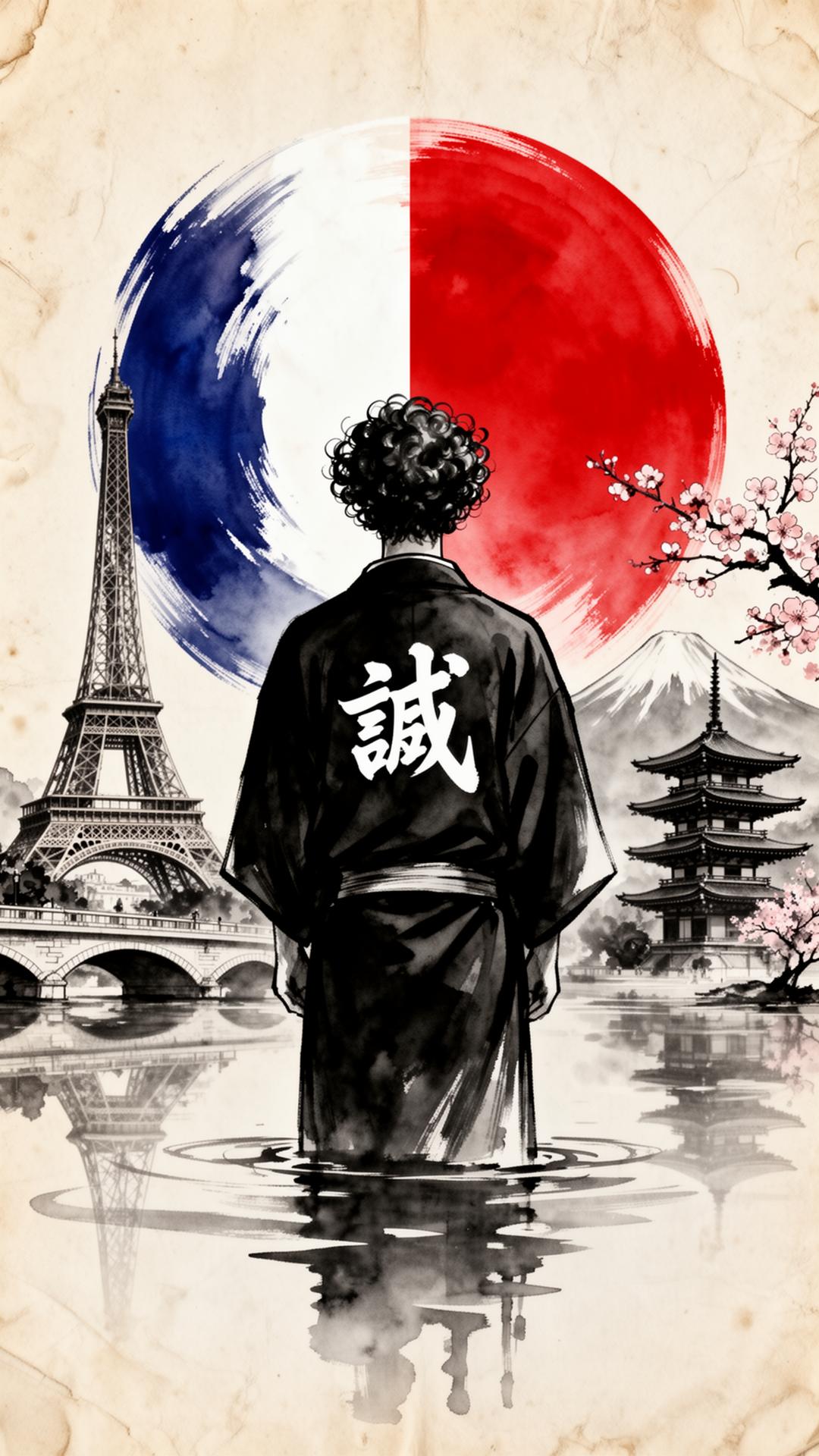
How I arrived
I did not choose Japan. Japan found me — through the woman I love.
I am French. I did not move to Japan with a plan, a vision, or a manifesto. I moved here because my wife is Japanese, and because love does not negotiate with geography. The universe, in its quiet randomness, placed me in Kyoto — and I said yes.
But arriving by chance does not mean staying without intention. The longer I live here, the more I feel something I can only call an obligation — to be worthy of this country, to understand it, to protect it. Not as a policy. As a personal oath.
I am still learning Japanese. I make mistakes every day. But I pay attention, I try, and I carry with me a perspective that perhaps only a foreigner rooted in another ancient civilization can offer — someone who has seen, with his own eyes, what it looks like when a great culture forgets to defend itself.
I did not choose Japan. But I choose, every day, to honor it.
Two civilizations, one soul
France and Japan are more alike than the world knows.
When I first arrived in Japan, I did not feel lost. I felt, strangely, recognized. Because France and Japan — beneath their surface differences — share a deep common spirit. They are both civilizations built on the art of living well.
La cuisine française
Food as culture, craft, and identity. The terroir. The season. The ritual of the meal.
Washoku
Food as ceremony, precision, and love. The bento. The dashi. The reverence for each ingredient.
L'élégance
Beauty in restraint. The perfectly cut coat. The understated gesture. Style as respect for others.
Wabi-sabi
Beauty in imperfection. The worn stone. The asymmetric bowl. Aesthetics as philosophy.
La courtoisie
Politeness as social contract. The bonjour. The held door. Civility as invisible architecture.
Omotenashi
Hospitality as complete philosophy. Anticipating the guest's need before it is spoken.
Both cultures love their seasons, mourn their passing, and celebrate their return. Both understand that civilization is not a given — it is something tended, daily, by people who care enough to maintain it.
When I bow in Kyoto, something in me that was always French understands exactly why.
A testimony from France
What happens when a civilization stops protecting itself.
France was once a country where the codes were clear — shared values, civic pride, a common relationship to public space, to noise, to cleanliness, to how you treat strangers. Those codes have eroded. Not all at once, but year by year, neighborhood by neighborhood, through decades of mass immigration without selection, without integration requirements, without honest public conversation.
The failure was not migration itself. The failure was the absence of discernment — the refusal to ask: does this person come to contribute? Do they respect the culture they are entering? Will they maintain the civilization they are joining?
These questions became unsayable in France. And because they became unsayable, they became unanswerable. And because they became unanswerable, the country changed — in ways most French people grieve privately, in ways they are afraid to name publicly.
I left a country that was beautiful and became afraid of its own beauty. I do not want Japan to make the same journey.
I write this not with hatred — I write it with grief. And with the hope that Japan, which has so far protected itself wisely, continues to do so with open eyes and the courage to be honest.
On love as active force
Love is not passive. Love defends what it holds sacred.
I believe in love as the supreme principle — not romantic love, not religious sentiment, but the conscious, unconditional force that seeks the well-being of all living things.
But love is not soft. Love is not silent in the face of harm. A father who loves his child does not stand aside when that child is threatened — he acts, with everything he has. Love without the willingness to defend is not love. It is comfort dressed as virtue.
The hierarchy of response
Understanding first — always. Compassion before judgment. Dialogue before force. But if understanding fails, if the harm continues, if what is sacred is being destroyed — then force is not a betrayal of love. It is love's final expression. I will use it if necessary. For Japan. Without hesitation, and without apology.
Love that will not act is not love. It is cowardice wearing a gentle mask.
The oath
What I believe a good gaijin owes Japan.
I am not here to tell Japan what to do. But I can speak for the foreigner who comes in the right spirit — and offer this as a measure, a mirror, a benchmark.
- 01
I adapt to Japan. Japan does not adapt to me. I am the guest; this is their home.
- 02
I learn the language — imperfectly, slowly, sincerely. Every effort is a form of respect.
- 03
I follow the codes — on trains, in streets, in temples — not because I must, but because I understand why they exist.
- 04
I leave places more beautiful than I found them. I pick up what others drop.
- 05
I speak well of Japan to the world. I defend it when it is misunderstood or unfairly attacked.
- 06
I support Japan's right to select who enters and who stays. Discernment is not cruelty — it is love for what has been built.
- 07
I am here because of love — and I am willing to defend what I love, by any means necessary.
To Japan
You have something rare. It is worth defending.
Japan is one of the last places on earth where a lost wallet is returned. Where a train arrives on time and silence is kept out of consideration for others. Where streets are clean not because of laws but because people care. Where beauty is not a luxury but a shared default.
These things are not inevitable. They are the result of a culture — maintained by people who respect themselves, each other, and the civilization they inherited. They can be lost. Slowly, then all at once. France is proof.
Good foreigners exist. We are your allies, not your problem. But Japan must maintain the courage to tell the difference — to ask the right questions, to select with discernment, and to never be shamed into silence about what it values.
Protect Japan — not because the world demands it, but because what Japan is deserves to continue.
About the author — Makoto
Kyoto · 京都
A Frenchman living in Kyoto. Arrived by love — married to a Japanese woman — and stayed by choice. Still learning the language, still learning the country, committed to both for life. This manifesto is personal, not political. It is a testimony from someone who has seen what a civilization looks like when it forgets to protect itself, written to one that has not yet forgotten.